Jupiter Supercomputer Powers Up, Setting a New Benchmark for European High-Performance Computing
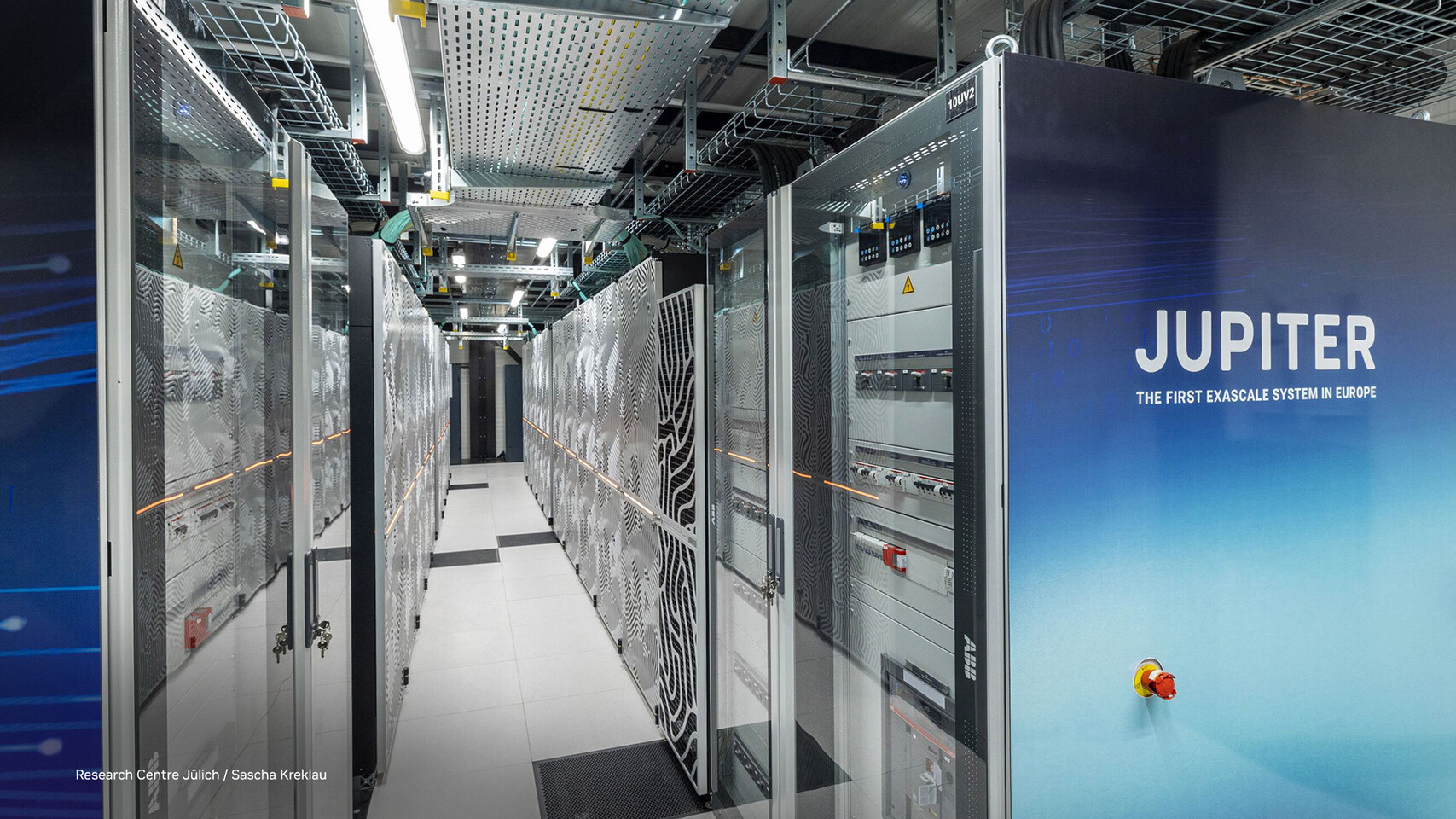
The European high-performance computing (HPC) landscape has reached a new milestone with the official activation of the Jupiter supercomputer at the Jülich Supercomputing Center. As the fastest supercomputer in Europe and ranked fourth globally on the Top500 list, Jupiter marks a significant leap forward in computational capabilities for the continent.
Exascale Performance and Advanced Architecture
Jupiter is a modular exascale system, delivering a peak performance of nearly one ExaFLOP (930 PetaFLOPS) in double-precision (FP64) calculations. The system is built around NVIDIA Grace Hopper technology, with its booster module alone contributing approximately 793 PetaFLOPS of FP64 performance. Each compute node is equipped with four GH200 accelerators, resulting in a total of 23,752 accelerators distributed across 5,938 nodes and housed in 125 server racks.
The GH200-class accelerators are recognized for their exceptional energy efficiency, achieving nearly 60.5 GigaFLOPS per watt. The entire accelerator array operates within a power envelope measured in double-digit megawatts, underscoring Jupiter’s commitment to sustainable high-performance computing.
AI-Optimized Computing Power
Jupiter is purpose-built for artificial intelligence workloads, delivering over 90 ExaFLOPS in the FP8 format favored by AI applications. This immense processing power positions Jupiter as a foundational platform for advanced AI research and development across Europe.
Strategic Investment and Digital Sovereignty
The construction of Jupiter represents an investment of approximately €500 million. Looking ahead, European planners anticipate the need for a multibillion-euro expansion to address future capacity requirements, with projections of around €60 billion for HPC and AI infrastructure deployments through 2030. Plans include the development of about 13 specialized AI data centers and gigafactory-scale facilities, with Jülich identified as a potential site for further growth.
This strategic investment is driven by the goal of digital sovereignty—ensuring that critical computing infrastructure remains within Europe to support local research, industry, and innovation, rather than relying on external cloud providers.
Supporting Scientific Research and Industry
Jupiter is set to play a pivotal role in a range of scientific and industrial applications, including climate modeling, materials simulation, and biological research. The system is complemented by an inference module, Jarvis, designed for rapid model serving and deployment. By anchoring AI and HPC capabilities within Europe, Jupiter is expected to catalyze further regional investment and innovation.
As an energy-efficient exascale platform, Jupiter not only enhances Europe’s computational capabilities but also signals a commitment to sustainable, sovereign digital infrastructure for the future.