Microsoft Unveils Enhanced DirectX Ray Tracing Specification
Microsoft has released a new functional specification for DirectX Ray Tracing (DXR), providing deeper insights into the future of real-time ray tracing technology. This updated documentation outlines the evolving architecture of the DXR pipeline, highlighting Microsoft’s goals for performance, scalability, and efficiency in next-generation graphics rendering.
Clustered Geometry: Streamlining 3D Rendering
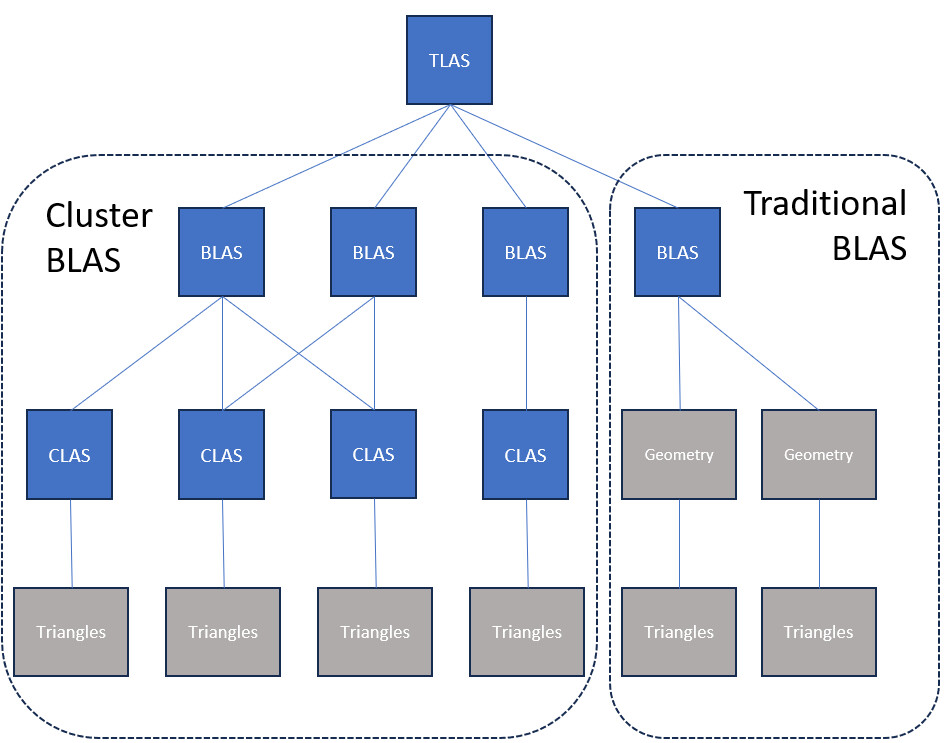
One of the key advancements in the latest DXR specification is the introduction of clustered geometry. Traditionally, 3D graphics are constructed from individual triangles, which serve as the fundamental building blocks of virtual environments. With clustered geometry, DXR groups nearby triangles into clusters, enabling the GPU to process, move, and instantiate these groups in bulk rather than handling each triangle separately.
This approach is supported by compact vertex encodings and predefined template formats, which optimize GPU memory usage and bandwidth. By minimizing redundant updates and duplication of geometry, DXR significantly reduces the computational load on the GPU. This is particularly beneficial for rendering complex scenes with dense foliage, crowds, or numerous in-game objects, resulting in smoother performance and more efficient ray tracing in modern games.
Partitioned TLAS: Modular Scene Management
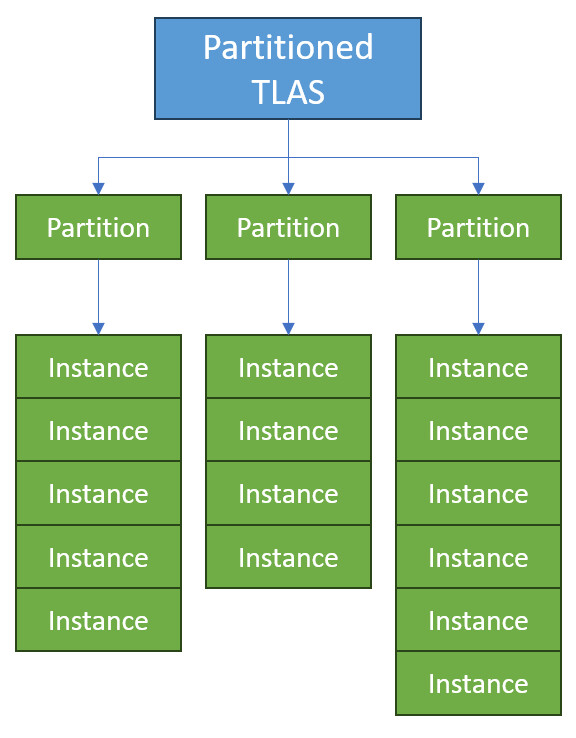
Building on the principles of modularity and scalability, Microsoft has introduced partitioned Top-Level Acceleration Structures (TLAS) in the new DXR specification. This feature divides the scene graph into smaller, manageable partitions, allowing the GPU to independently translate, resize, or update specific sections of the game world.
For open-world games and expansive environments, this means the GPU can focus ray tracing computations only on relevant scene elements, rather than re-rendering the entire environment. Partitioned TLAS supports dynamic content updates and enhances overall rendering efficiency, aligning with Microsoft’s vision for flexible and high-performance graphics pipelines.
Indirect Acceleration Structure Operations: Shifting Workloads to the GPU
The updated DXR specification also introduces indirect acceleration structure operations, a feature designed to offload more tasks from the CPU to the GPU. Traditionally, many DirectX 12 API calls—such as building, compacting, moving, and instantiating geometry—require CPU intervention, which can create bottlenecks and increase system latency.
With indirect acceleration structure operations, these processes are now managed directly by the GPU’s command stream. This shift enables greater data parallelism, reduces latency, and improves overall ray tracing performance, especially in scenes with complex geometry and dynamic content.
Advancing Real-Time Ray Tracing Performance
Microsoft’s latest DXR functional specification marks a significant step forward in real-time ray tracing technology. By introducing clustered geometry, partitioned TLAS, and indirect acceleration structure operations, the company is addressing key challenges in scalability, efficiency, and performance. These innovations are set to empower developers to create richer, more immersive gaming experiences while optimizing hardware utilization across a wide range of devices.