NVIDIA GeForce RTX 60-Series: What to Expect from the Next-Gen "Rubin" Architecture
The tech community is abuzz with early rumors about NVIDIA’s upcoming GeForce RTX 60-series graphics cards. Despite current market fluctuations, NVIDIA appears committed to its established two-year product launch cycle, ensuring a steady evolution of its GeForce lineup. The next generation will be powered by the new "Rubin" graphics architecture, which has already made its debut in NVIDIA’s AI GPU series and is now set to enhance gaming performance, according to reports from RedGaming Tech.
Advanced Manufacturing and Architecture
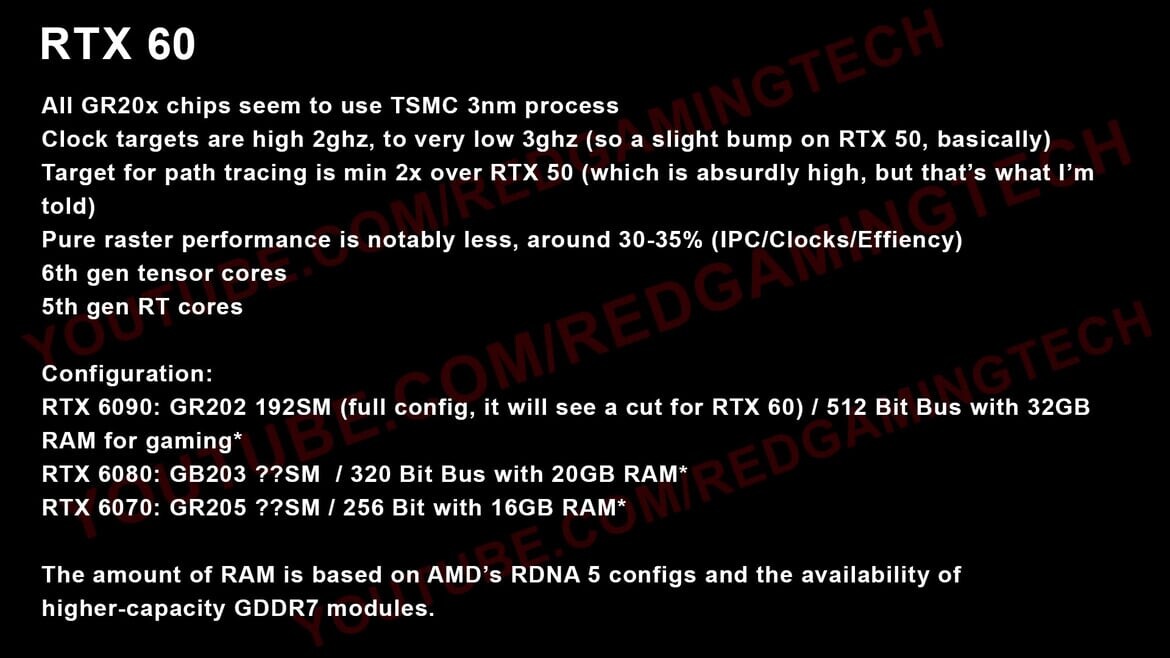
Initial leaks suggest that NVIDIA will take a measured approach with its foundry technology for the GeForce RTX 60-series. Rather than adopting a sub-2 nm nanosheet-based node, the "Rubin" GPUs will utilize a variant of TSMC’s 3 nm FinFET process. This may not be the same N3 node used by other industry leaders like Apple and Intel; NVIDIA could collaborate with TSMC to develop a custom variant, similar to the NVIDIA 4N node derived from TSMC’s N5 process.
The new chips will follow a "GR20x" naming convention, with the flagship silicon expected to be labeled "GR202." The 3 nm process is anticipated to support GPU clock speeds in the high 2 GHz to low 3 GHz range, offering a modest increase over the current "Blackwell" generation.
Next-Generation Tensor and RT Cores
The GeForce "Rubin" series will introduce 6th Generation Tensor cores and 5th Generation RT (Ray Tracing) cores. The upgraded Tensor cores are designed to accelerate neural rendering and support DLSS 5, NVIDIA’s latest AI-powered upscaling technology. Early demonstrations of DLSS 5 required dual RTX 5090 cards, but the goal for the Rubin architecture is to deliver this advanced feature on a single GPU, making it accessible even to mid-range and performance-tier models.
The 5th Gen RT cores are expected to deliver a significant leap in real-time path tracing performance, with NVIDIA reportedly targeting a 100% improvement over the current RTX 50-series "Blackwell" GPUs.
Performance and Efficiency Gains
In terms of traditional rasterized 3D graphics, the "Rubin" architecture is projected to offer generational performance gains of 30% to 35% on a SKU-to-SKU basis compared to the RTX 50-series. These improvements will be driven by advances in instructions per clock (IPC), higher clock speeds, and enhanced energy efficiency enabled by the 3 nm process and the new streaming multiprocessor (SM) design.
Memory Upgrades Across the Lineup
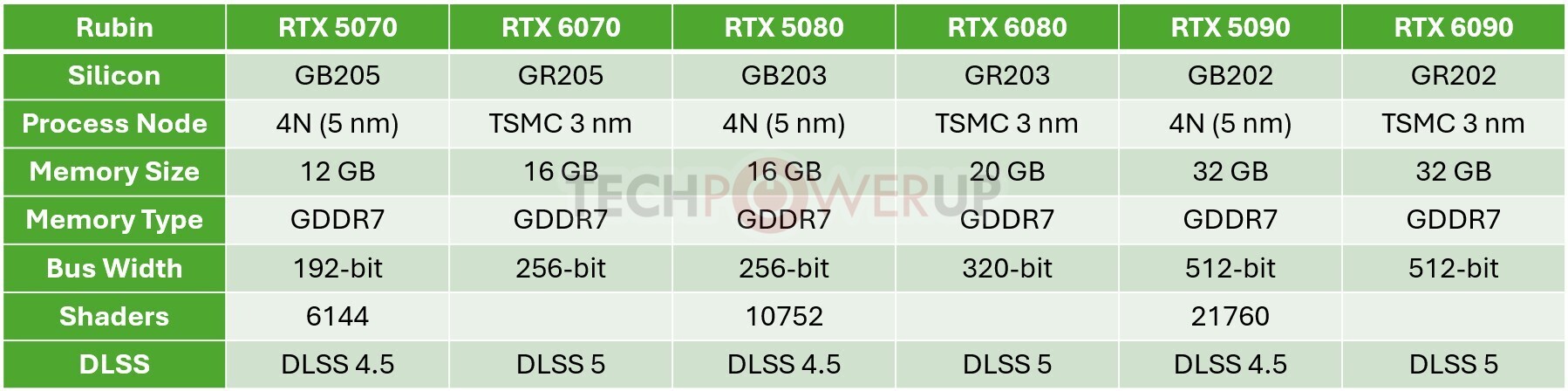
Memory capacity and bandwidth are also set to improve across the RTX 60-series, with the exception of the flagship RTX 6090, which will maintain a 512-bit GDDR7 memory bus similar to its predecessor, the RTX 5090. NVIDIA may leverage faster GDDR7 modules for incremental bandwidth gains, and the top-tier silicon is expected to feature 192 SMs, though the RTX 6090 itself may use a slightly reduced configuration. The 32 GB memory size is likely to remain unchanged for the RTX 6090.
The RTX 6080 is rumored to be based on the "GR203" silicon, featuring a 320-bit GDDR7 memory interface and 20 GB of memory. This would result in at least a 25% increase in memory bandwidth over the current RTX 5080.
The RTX 6070 will see a substantial boost in both memory size and bandwidth. Built on the "GR205" silicon, it will offer a 256-bit GDDR7 memory interface and 16 GB of memory, translating to at least a 33% increase in memory bandwidth compared to its predecessor.
Looking Ahead
While these details are based on early leaks and industry speculation, they provide a glimpse into NVIDIA’s strategy for the next generation of gaming GPUs. With the Rubin architecture, NVIDIA aims to deliver meaningful improvements in AI-driven features, ray tracing, and overall gaming performance, while maintaining a focus on efficiency and memory advancements. As the official launch approaches, more concrete information is expected to emerge, offering further insights into what gamers and professionals can expect from the GeForce RTX 60-series.