Intel Reports Strong Q1 2026 Earnings with Significant Foundry Yield Improvements
Intel has announced robust financial results for the first quarter of 2026, highlighting notable progress across its core business segments, including Intel Products and Intel Foundry. Both divisions demonstrated operational enhancements, but the standout achievement came from Intel Foundry, which reported substantial yield improvements across all major foundry nodes currently in high-volume manufacturing. These nodes—Intel 4, Intel 3, and the advanced 18A—form the backbone of Intel’s product lineup.
Yield Improvements Drive Operational Efficiency
During the Q1 2026 earnings call, Intel CFO David Zinsner emphasized the company’s ongoing efforts to enhance yields on both legacy and cutting-edge nodes. Intel continues to optimize yields for its established Intel 4 and Intel 3 nodes, while also refining the performance of the 18A node. These improvements are crucial for reducing manufacturing waste and increasing the number of functional chips produced, even as die sizes grow larger.
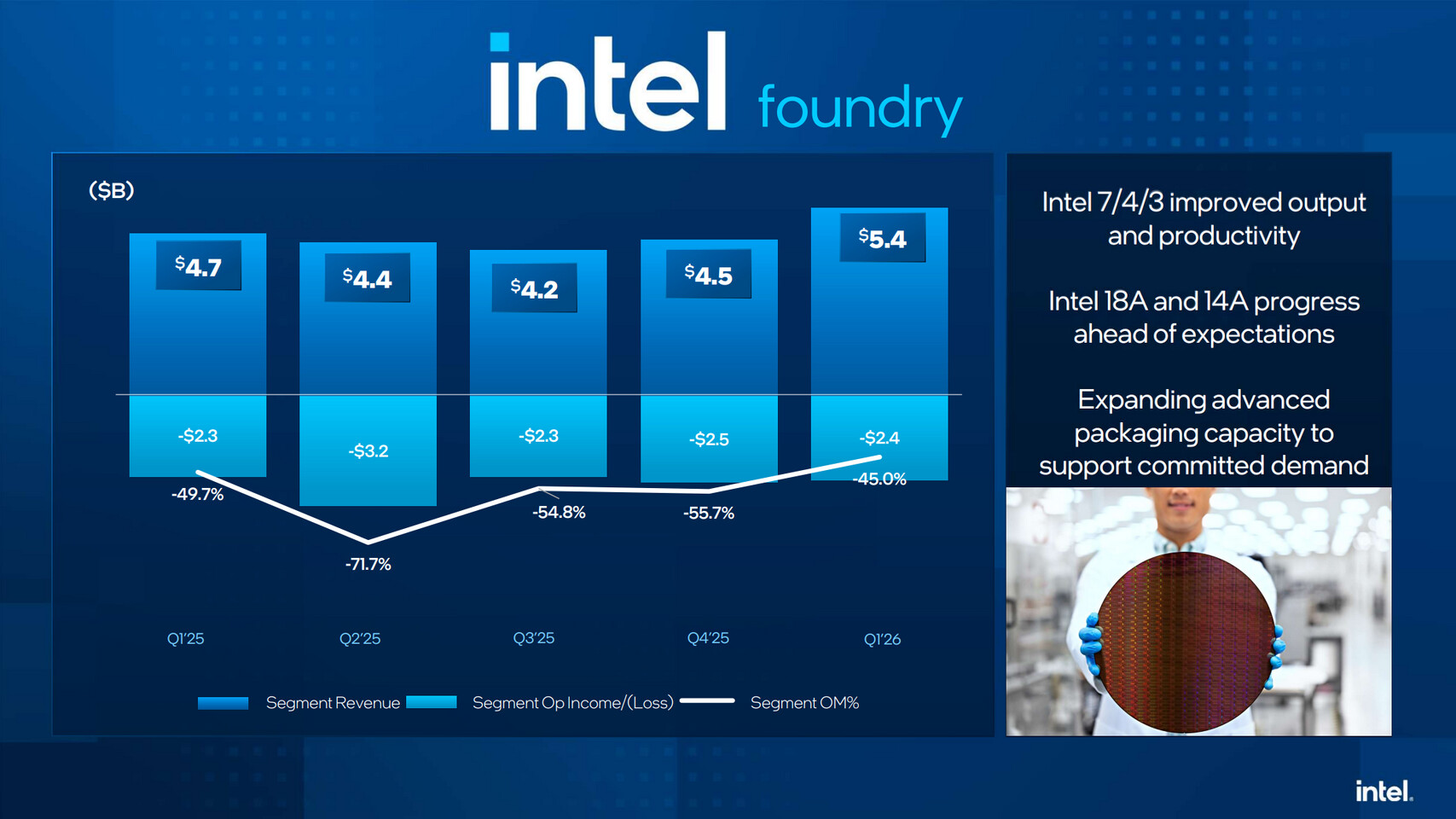
Intel Foundry reported an operating loss of $2.4 billion for the quarter, an improvement of $72 million compared to the previous quarter. This positive trend was largely attributed to better yields on Intel 4, Intel 3, and 18A nodes, which contributed to higher gross margins. However, increased operating expenses—primarily due to strategic investments in the upcoming Intel 14A node—partially offset these gains. Intel Foundry continues to bear the majority of costs associated with the early ramp-up of the 18A node, but the company anticipates further reductions in operating losses as 18A production scales and yields continue to improve throughout the year.
Milestones and Customer Engagement
In Q1, Intel Foundry exceeded output expectations, maintained steady yield improvements, and achieved key milestones for the 14A node. This progress signals that Intel’s foundry revitalization strategy is on track, with yield enhancements forming a critical component of the broader transformation.
One of the most notable developments is the announcement that Tesla, led by Elon Musk, will be the first major customer for Intel’s 14A node. While specific details remain undisclosed, this partnership underscores growing industry confidence in Intel’s advanced manufacturing capabilities.
Intel is also focused on updating its process design kits (PDKs) for both the 18A and 14A nodes. The 14A node is currently at the 0.5 PDK stage, with further refinements expected as the PDK 0.9 version is released. This iterative process allows customers to finalize volume, design, and technical requirements, ensuring that Intel’s manufacturing processes align closely with customer needs. Ongoing collaboration and feedback integration are central to Intel’s approach, supporting continuous improvement and innovation in semiconductor manufacturing.